The Rise of the Third Workplace: Are Work Cafés the Future of the Office?
In 2026, a study found that 22% of remote workers are spending at least half a day per week working from spaces such as cafés, libraries or restaurants. This trend is being repeated around the world, with remote or hybrid employees opting to work in neutral spaces, or ‘third places’, beyond their home and office.
Third places are typically hospitality environments or communal public spaces. But increasingly, they are adopting the tools and tropes of the modern office – with full connectivity, power access, workspace, good ergonomics and acoustics. 24/7 work‑friendly cafés are pushing this trend even further.
So, in an era in which offices continue to borrow heavily from hospitality design, hospitality spaces and third places are becoming geared for work. As typological boundaries blur and once-fixed distinctions dissolve, could it be we are witnessing the rise of the third workplace? And what are the implications of these shifts for office designers, employers and staff?
WRKPLC decided to investigate.
What is a third place?
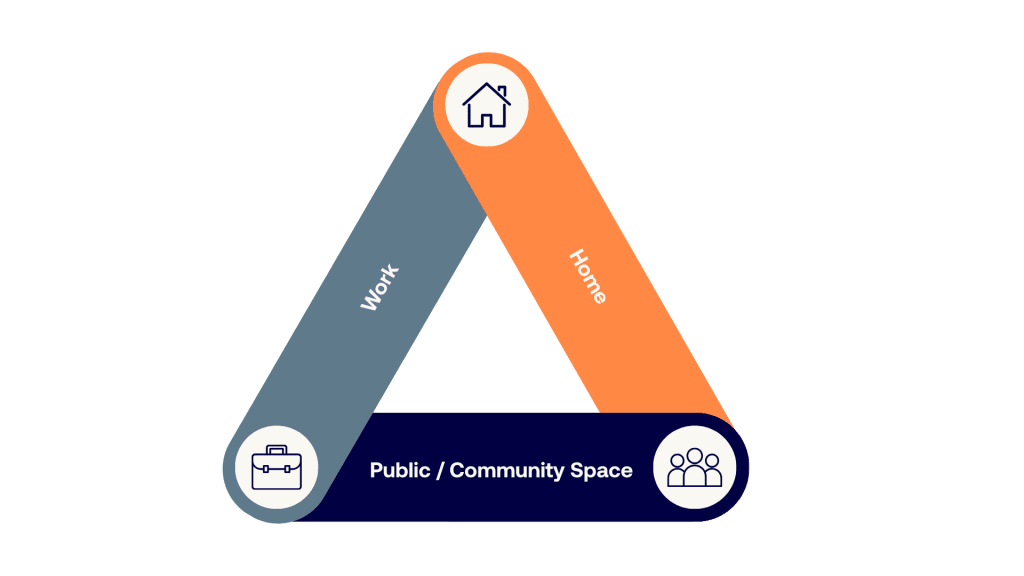
The term ‘third place’ refers to a public venue such as a café, pub, community centre, club or bar. It was coined by the American urban sociologist, Ray Oldenburg, who argued that healthy communities depend on informal, welcoming social spaces beyond home, which he identified as the first place, and work, which he called the second place. These ‘third places’ are neutral, convivial environments where community is the main focus and social ties form easily.
Oldenburg first articulated this concept in 1982 in an academic article published in Qualitative Sociology. He then expanded and developed his theory in his 1989 book, The Great Good Place. In these works, Oldenburg defined third places as accessible, low‑cost public spaces that encourage voluntary, face‑to‑face interaction. They act, he suggested, as “community anchors,” nurturing belonging, sociability and civic life.
In the four decades since Oldenburg first articulated his thesis, third places have evolved. Economic pressures, urban sprawl and digital displacement have eroded traditional third place environments like pubs and libraries, while new hybrid venues – cafés-as-offices, coworking hubs, community gardens – have emerged. Members’ clubs have also developed to embrace the third place ethos. Members’ clubs have of course been around for hundreds of years, but in recent years franchises like Soho House have expanded the idea of providing home-from-home social space and workspace for professionals, rooted in hospitality design.
The London-based luxury members’ club Third Space has monopolised this concept, even making oblique reference to Oldenburg’s theory by name and leveraging it in their marketing. Providing world-class health, fitness and wellbeing facilities, plus spaces for informal work, these high-end establishments are “bound by a common philosophy: to be the Third Space for our members, inspiring them to be their personal best”. But where Oldenburg envisaged neutral space that was democratic, inclusive and cheap, these new third places are exclusive, with an exceptionally high price of admission.
How is the third place concept influencing the workplace?
For some time now, designers have been trying to create compelling workspace propositions by bringing hospitality into the office. It’s a trend that has accelerated in recent years, driven by multiple factors – including the evolution of the third place.
While modern professionals seek hospitality-style third places away from home and work, designers are increasingly looking to replicate these environments within the workplace. In the post-pandemic era especially, companies have been attempting to entice employees back into the office by appropriating hospitality design cues and tropes. With hybrid and work-from-home models becoming the norm, and with employees’ expectations shifting, employers are having to think harder about how to make the modern office a place where people want to be. For many, the answer lies in moving away from traditional corporate environments and putting amenity, wellbeing, comfort and convenience at the heart of the workplace experience.
To this end, many contemporary workspace design schemes incorporate cafés, lounges, soft furnishings, lobbies, gyms, terraces and concierge-style services. The design language of the workplace is no longer a desk and a meeting room. Today, workplace design is about creating spaces for recreation, collaboration, connection and informal social interaction – spaces, in fact, that fulfil the primary function of the third place as defined by Oldenburg.
Indeed, as a recent WRKPLC survey confirms, 57% of employees say they come into the office to collaborate with colleagues, while 11% say the office provides an opportunity to catch up with people. The community dimensions of the third place, therefore, are increasingly shaping employee expectations and, in turn, asserting a major influence on workplace design and development.
From third place to third workplace
The boundary between where people work and where people simply are has been blurring for years, but the shift has recently accelerated. Third places – those informal, convivial social environments beyond home and office – are increasingly absorbing the tools and spatial cues of contemporary work. What began as cafés offering Wi‑Fi has matured into a full convergence: hospitality venues now design for laptops, power access, acoustics, ergonomics and extended dwell time with the same intentionality once reserved for offices.
Meanwhile, if workplaces have borrowed from hospitality to feel warmer, softer and more community focused, hospitality is now borrowing back, adopting the infrastructure and rhythms of work. Many cafés, hotel lobbies, libraries and members’ clubs already function as de facto coworking spaces, supporting freelancers and remote workers who treat them as flexible extensions of their professional environment. The rise of 24/7 work‑friendly cafés pushes this trend further, offering round‑the‑clock access, charging points, community programmes and spatial layouts optimised for concentration and casual collaboration.
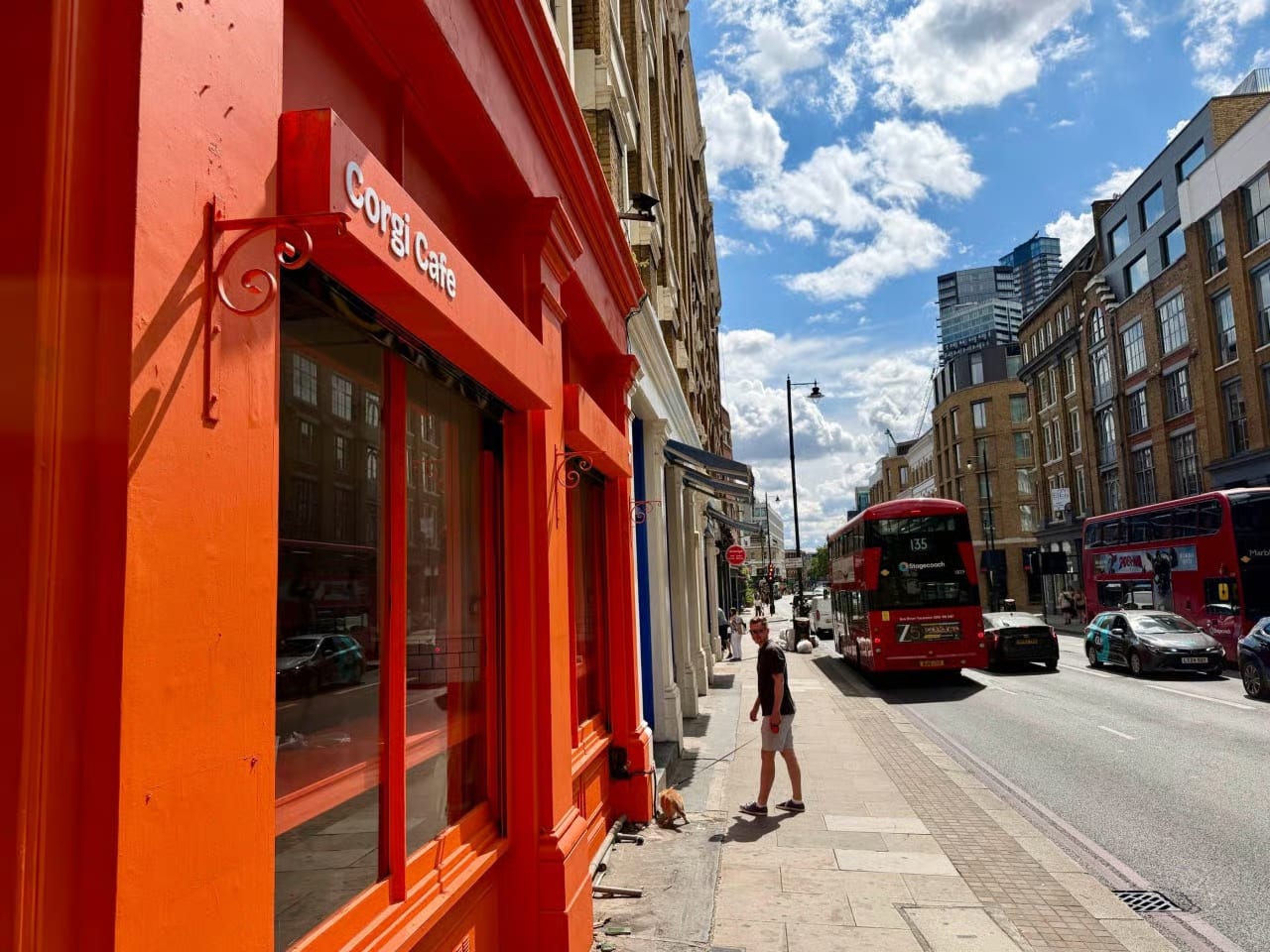
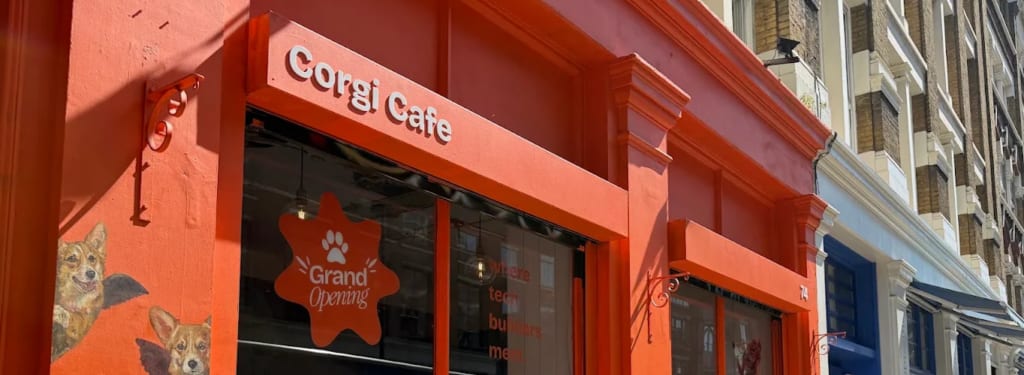
London’s Corgi Café exemplifies this hybridisation. Dubbed a ‘24/7 café for builders’, Corgi Café is aimed at ambitious young entrepreneurs (the ‘builders’ of companies), offering them a co-working start-up hangout in the heart of Shoreditch. Playful and themed, it is unmistakably a third place in its social energy, yet unmistakably a workplace in its amenities: reliable Wi‑Fi, comfortable seating, predictable opening hours and an atmosphere calibrated for both sociability and productivity. It is a social anchor and a work node simultaneously.
As offices become more like third places (informal, human‑scaled, hospitality‑inspired) and third places become more like workplaces (structured, equipped and intentionally designed for work) the distinction between the two dissolves. What emerges is a new hybrid category: the third workplace, a socially rich, work‑enabled environment that blurs boundaries and reshapes how, where and with whom work happens.
Why are third workplaces becoming more popular and relevant?
Third workplaces are on the rise because they solve a number of modern working tensions. Hybrid and remote models have freed people from fixed office arrangements, giving them far greater choice over where work happens. Yet that freedom comes with friction: long commutes feel unnecessary when only part of the week requires presence, and working from home can create isolation and monotony. It can also impact domestic life. People want autonomy without losing social connection.
Third place neighbourhood working has emerged as a powerful alternative. Instead of travelling into central offices, workers look for spaces closer to home; places that offer structure, atmosphere and social contact, without the intensity of a corporate environment. Third workplaces meet this need by providing a middle ground: not home, not office, but a flexible, work‑oriented environment embedded in everyday life.
Flexible schedules further underscore why this model is becoming increasingly relevant. When people work early, late or in irregular bursts, they need spaces that match these rhythms, rather than rigid nine‑to‑five routines. Community hubs and hybrid hospitality venues offer extended hours, drop‑in access and environments that support both focus and casual interaction.
Underlying all of this are changing employee expectations. Workers increasingly value autonomy, wellbeing, choice and environments that feel human rather than institutional. Third workplaces provide atmosphere, community and comfort while still enabling productivity. They align with how people actually work today; that is, fluidly, socially and across multiple settings, making them an increasingly relevant part of the contemporary work landscape.
WRKPLC’s top 3, free work cafés in London
Looking for a work cafe in London? Whether you need a cafe to work in London, a study cafe or simply some laptop-friendly cafes, we’ve picked three of the best free places to work in London when you need a change of scenery.
1. Corgi Café
- Hours: Open 24hrs, 7 days a week.
- Built-in networking eco-system, with free professional photos for events.
- High-Speed WiFi with plug sockets tailored for tech stacks and laptops.
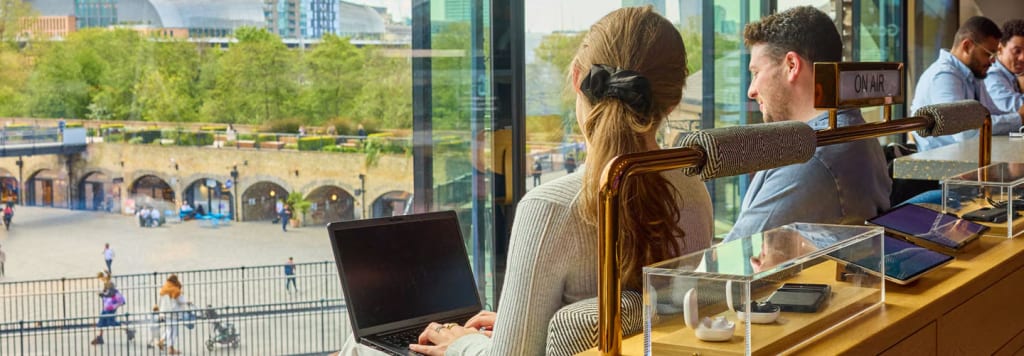
2. Samsung Work Café London, King’s Cross
- Hours: Mon–Sat 11:00 AM – 7:00 PM, Sun 11:00 AM – 5:00 PM.
- “On Air” Lounge with comfortable window seating and great views away from traditional desks for creative work.
- Access to onsite tech experts.
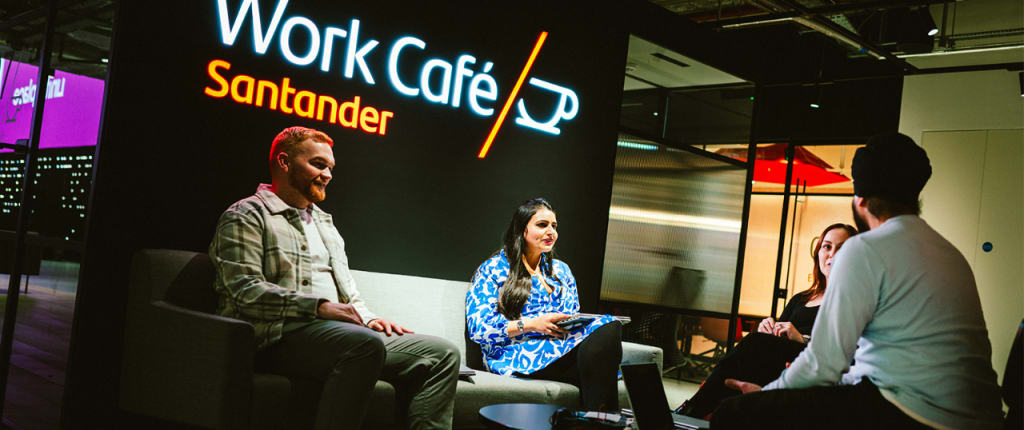
3. Santander Work Café London, Cheapside
- Hours: Mon–Fri 8:00 AM – 4:00 PM
- Bookable meeting rooms with video conferencing screens for up to 2hrs free for Santander and TSB Banking customers.
- 30% drink discount for Santander and TSB Banking customers.
Are work cafés becoming the new third workplace?
Work cafés are emerging as a distinct category of hybrid work venue; not simply cafés that tolerate laptops, but purpose-built environments designed for professional activity and community.
Ordinary cafés have long offered ambient refuge for freelancers and remote workers, yet their primary logic has always been hospitality. What’s new is the rise of spaces that – as with the Corgi Café above – intentionally blend work infrastructure and hospitality, creating a hybrid ecosystem that sits between the café, coworking space and office.
Some of these work cafés offer 24/7 access, reliable Wi‑Fi, ergonomic seating, bookable rooms and power everywhere. But they also retain the warmth, sociability and sensory appeal of hospitality-led environments. They host events, talks, workshops and micro‑gatherings that cultivate a professional community, rather than a purely social one. In this way, networking becomes intuitive rather than forced, with visitors benefiting from a mix of serendipity and lightly curated encounters.
In an era where people seek flexibility and autonomy, work cafés function as viable third workplaces. They are neither corporate nor domestic, neither fully public nor fully private. They provide a setting where work, meeting, learning and social connection coexist, offering a new model for how professionals can gather, collaborate and build networks for the future.
The space between cafés, coworking and the office
Within the third workplace landscape, different locations and venues offer different benefits and constraints. Some of these are captured here:
| Dimension | Café | Coworking space | Office | Work Café | Home |
| Work | Light, informal, laptop friendly but not optimised; variable ergonomics | Strong work infrastructure, desks, meeting rooms, reliable Wi Fi | Full professional setup, dedicated desks, equipment, privacy | Hybrid; café ambience with intentional work zones | Highly variable; personalised but limited by domestic constraints |
| Hospitality | Service-led, comfort and convenience-focused; food & drink, social warmth | Amenities, coffee, snacks and communal facilities | Functional, corporate, service-minimal – but increasingly incorporating hospitality design cues | Hospitality amenities integrated with workspace | Self service, with comfort dependent on home setup |
| Community | Loose, ambient, unstructured; regular faces but low interaction | Curated community, events and shared identity | Organisational community; structured, hierarchical | Socially vibrant but work-oriented, with opportunities for networking | Personal community only; isolated from broader work networks |
| Networking | Serendipitous, unpredictable | Intentional networking, proximity to freelancers/startups | Internal networking; limited external exposure | Casual collisions with professionals, with some structured events | Limited to digital channels |
| Access | Open to all; pay as you go | Membership or day-pass; controlled access | Restricted to employees | Open but with commercial framing; sometimes membership-based | Fully accessible but private; no external access |
| Hours | Long hours; early-to-late; weekend-friendly | Business hours with some extended access | Standard office hours | Extended hours; flexible depending on operator | 24/7, self determined |
Why 24-hour workspaces could change where and how we work
Twenty‑four‑hour workspaces could open up a new rhythm of professional life, offering flexibility without sacrificing the structure and resources of a dedicated work environment.
They support people whose working patterns fall outside the traditional nine-to-five, such as shift workers, creatives, global teams and anyone collaborating across time zones. With constant and unrestricted access and open hours, work becomes something that can be shaped around energy levels, responsibilities and personal priorities and routines. This reduces commuting pressure, enables more intentional work‑life balance and creates a professional setting that adapts to the realities of modern, distributed working.
Is community becoming a workplace amenity?
As seen in the results from the WRKPLC survey above, community is an increasingly important driver of employee engagement and in-office attendance.
For many people, the choice of workspace is shaped by the opportunity for connection. Within and beyond a company’s own walls, professionals seek communities that reflect their industry, interests or creative identity; places where proximity generates ideas and collaborations. Industry‑led or interest‑driven spaces create this fertile ground, offering events, talks and workshops that enable natural networking.
In this context, community becomes a powerful draw: not just a social benefit, but a strategic one. It also raises a pertinent question for employers; is community now considered a key amenity within corporate environments? And if so, can the prospect and promise of community be leveraged to get people back into the office?
What are the disadvantages of third workplaces?
As seen in this article, third workplaces offer many benefits and opportunities. But they also come with significant drawbacks. Seating, lighting and desk setups rarely match the comfort or support of a dedicated office. Security can be a concern too, with public Wi‑Fi, shared spaces and limited control over data privacy. Noise and distraction are inherent risks, making focused work unpredictable and at times difficult. Many third workplaces rely on fragile business models, balancing hospitality with workspace demands, which can lead to suboptimal provision in both areas. And as these spaces encourage constant availability, they can unintentionally promote an ‘always‑on’ culture that erodes boundaries and leads to worker fatigue and disenchantment.
Will third workplaces replace the office?
At WRKPLC, we believe that third workplaces are unlikely to replace the office as we know it; at least, not entirely. This is because company workplaces still provide functions that cafés, coworking spaces and other third places cannot easily replicate – for example, dedicated IT support, security, fully professional facilities, organisational culture and structured team coordination.
As we see it, the future may involve an ecosystem of workplaces, with hub-and-spoke models, distributed offices and third workplaces all working together. Work location is likely to become more task-dependent, which will put more pressure on centralised offices to demonstrate a clear purpose and value-addition. The future of work may therefore be less about one default workplace, and more about fluidity and movement between different spaces.
What can employers learn from the rise of third workplaces?
By looking at third workplaces, employers can begin to understand why people choose to work in certain spaces. These choices provide insight into how to create compelling work environments that meet employees’ needs, and how to articulate a clear office purpose.
Companies also need to think beyond desks and meeting rooms. Hospitality matters, particularly in the era of remote and hybrid working. Employees whose expectations around amenities, comfort and convenience are not met will be voting with their feet.
Employers should also take note of the community appeal of third workplaces, which provides clear implications for office design (communal spaces, collaboration zones) and programming (workshops, talks, townhalls).
The rise of third workplaces also signals that employees increasingly value autonomy and environments that support different modes of work. Employers should respond by offering genuine choice within the workplace; for example, varied settings for focus, collaboration, social connection and quiet recovery. At the same time, they need to consider the wider workplace ecosystem, recognising that people now work across diverse work locations. Supporting this fluidity can strengthen engagement, reduce friction and position the office as one meaningful option, rather than the default.
What does the future of the workplace look like?
The future of the workplace is unlikely to be the office or the third workplace, but a combination of environments that serve different needs. In the words of WRKPLC Director Sean Espinasse:
“Work is becoming less tied to a single destination. Home, company offices, coworking spaces, work cafés and other third workplaces could increasingly form part of the same workplace ecosystem. The real shift is towards flexibility and providing better choice. As offices become more welcoming and hospitality-focused, there can be rub with the needs to concentrate. The future probably isn’t about replacing or segregating the office, but about having a broader mix of setting that responds to the personal desire to access and utilise well designed 3rd spaces.”
FAQs / People also ask:
A third place is an informal social environment designed for community and open access, whereas a coworking space is a formal, purpose‑built workplace offering structured amenities. Third places are typically casual, pay‑as‑you‑go and socially oriented; coworking spaces often require membership, provide dedicated work zones and support professional networking.
Yes, but with caveats. Many remote and hybrid policies allow café working for focused tasks, though some roles require approved locations. Wi‑Fi can be unreliable and public networks pose security risks unless you use a VPN or hotspot. Privacy is limited, making cafés suitable for low‑sensitivity work rather than confidential meetings.
Working from a third place offers flexibility, letting people choose environments that suit their mood or tasks. It reduces isolation by offering light social contact, while fostering community and networking through casual encounters. As an alternative to home or office, it provides variety at relatively low cost, often pay‑as‑you‑go rather than membership‑based.
A good work café combines reliable Wi‑Fi and abundant power with seating that supports longer working sessions. It offers a mix of quiet zones for focus and collaborative areas for meeting. Strong hospitality amenities, quality food and drink and an inviting atmosphere encourage people to work and connect comfortably, which in turn increases dwell time.
Looking for advice on your next office?
Talk to a workplace expert
By submitting your email address, you agree to our Privacy Policy and Terms & Conditions.